Hermit Cookies

I found a recipe that includes such a wealth of detail that my grandfather had to use the back of the card when he transcribed it.

This recipe for hermit cookies comes from Noni’s good friend, Mary Kileen.  I never met her, but was frequently reminded that she gave Noni some treasured figurines of naked babies that held a prominent place in the kitchen.

I remember eating these hermit cookies, and enjoyed them more than the naked babies.  Their name seemed whimsical and reminded me of my first pet hermit crabs.  But as a kid, hermits weren’t my favorite cookies; they seemed a little too virtuous and healthy.  Raisins, nuts, their medium-brown color…Noni’s hermits were cookies, but they seemed suspiciously similar to granola bars.

The spicing and seeming healthfulness made hermit cookies appeal to me as an adult and parent.  They’re sweetened with molasses as well as sugar, and lack any icing or chocolate.  According Bon Appetite, hermit cookies were valued for their healthfulness as far back as 1890.  My childhood self would say this is sneaky and uncool, but as an adult, this history is fascinating and, it turns out, quite tasty.

We took Mary Kileen’s recipe for a spin on a rainy afternoon.  My four-year-old put on an apron alongside me to be a sous-chef.  In addition to this relatively detailed recipe, I also took out my copy of the Better Homes and Gardens Cookbook, and referred to the hermit cookie recipe there to make sure I wasn’t overlooking any steps.

Since the recipe calls for sour milk and I didn’t have any, I made it by mixing together milk and lemon juice.  Better Homes assured me that I could also use milk and vinegar.

While the milk mixture sat out, my sous-chef and I measured butter (rather than Noni’s margarine) and sugar, and creamed them together in the standing mixer.

While that mixed, we measured out the nutmeg, cinnamon, and cloves, along with some salt and baking soda.  Sous-chef approved of all but the nutmeg, which made her wrinkle her nose as she sniffed it.  They were quite attractive in their little prep bowl, and soon made our butter-and-sugar mixture a lovely brown.

A hearty dose of molasses also helped, and we added flour and sour milk along with it.  Next up: raisins (or, “dried grapes” according to sous-chef) and slivered almonds.

Following Noni’s recipe, we made sure to add the beaten egg last.

I made a judgement call about spreading this cookie dough in the pan.  Better Homes said to drop the dough by spoonfuls onto a greased pan.  Noni’s just said to spread the dough to 1/2″ thickness.  I only had one baking pan with sides available (the other was waiting for a pizza), so I spread all the dough into one pan to 1/2″ thickness.  While technically following Noni’s instructions, this differed from what she did in practice.  I remembered later on that she spread the dough in strips, akin to biscotti, using more than one pan to do so.  But this dough just fit into one pan, so into the oven it went.

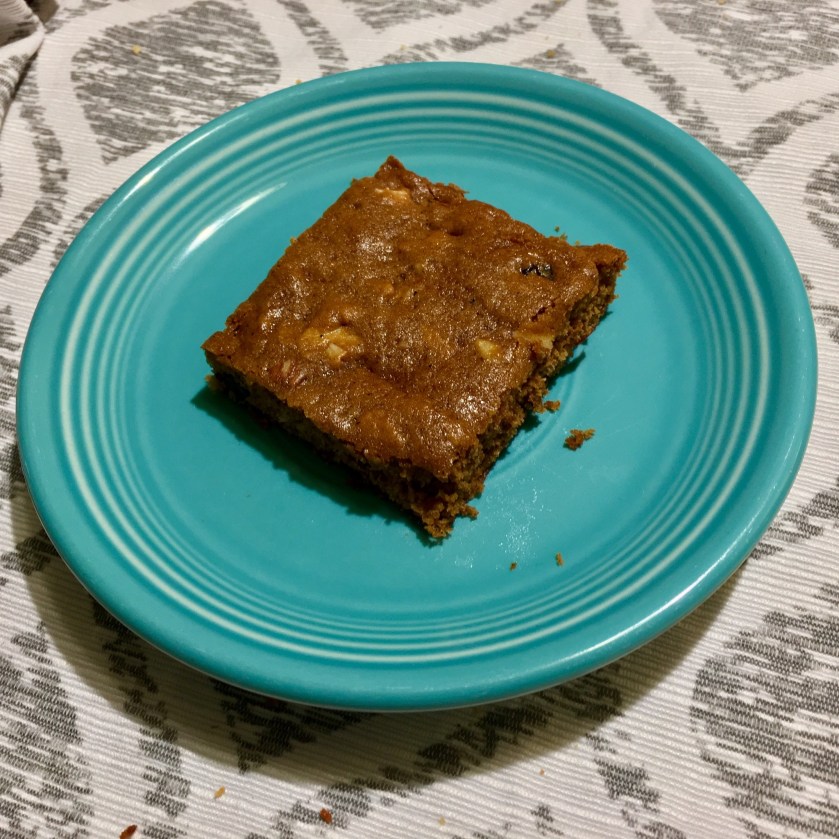
They puffed up nicely after baking for 14 minutes.  I left them in the oven for longer than the recipe specified to make sure the giant tray-cookie baked all the way through in the middle.  After testing several times with a toothpick, 14 minutes was the sweet spot for baking them through without drying them out.  I let them cool, then sliced them into rectangles, like brownies.  It turns out that this is the traditional way to make hermit cookies.  The recipes yielded a whopping 48 cookies.
1F42D5BB-9908-4A47-8C16-54F662F24A75

They were tastier than I remembered, and still recognizably Noni’s hermits.  I think they came out moister than hers, though it might be more fair to compare a frozen-and-defrosted version before passing final judgement.  I don’t know enough about baking science to say whether the substitution of butter for margarine had anything to do with it.  Noni used chopped walnuts in her hermits, but I used slivered almonds because that was what we had at home.  The almonds made them a bit sweeter.  There were good indications that my family liked them: my husband suggested making the cookies bigger, and my kids asked for them as “lunch dessert” (which is not a thing, but we broke our rules just this once).  I may try making them in strips, like biscotti, and will for sure make them again.

Here’s the recipe with all the details filled in and explained.  Enjoy them because of, or in spite of, their healthfulness.

Noni’s Pizza

After my first, not-disastrous attempt, I tried making Noni’s pizza a second time, with greater success.

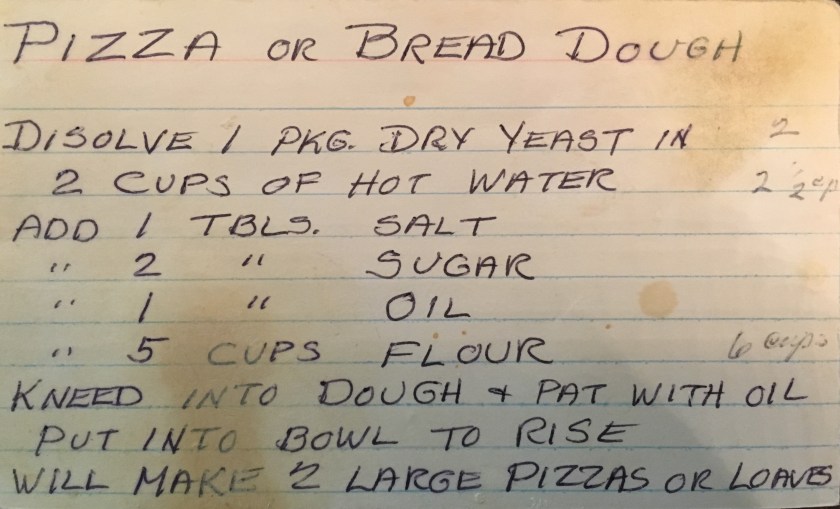
I stuck with the original recipe, but used The Joy of Cooking to fill in the details that are missing in this one:

IMG-7118

The ingredients are the same in both recipes, but the amounts differ.  Noni’s has a higher yield, and calls for more water, more flour, and more sugar than The Joy of Cooking.  Consulting a reference source helped me to figure out the times for mixing the ingredients, kneading, letting the dough rise, etc.

I also appreciated that Joy suggested first mixing the yeast and hot water in the mixer bowl, thus eliminating one dirty measuring cup (because why would I wash something that only held water).  Finding little efficiencies like this is super satisfying to me.

The dough came together in much the same way as it had the first time.  When baking with my dad as a kid, I’d been taught to mix the sugar with the yeast and hot water.  I think it was something about the yeast consuming the sugar, but since neither recipe specified this, I didn’t do it.

I departed from Noni’s recipe in letting the standing mixer do all the kneading.  While this wasn’t how she made pizza dough, Joy indicated that kneading with the mixer or by hand were both options that would work.  I wanted to try using the mixer for kneading because I’d be more likely to make this in the future if it required less hands-on time.  I set it on low, assuming that it can knead more consistently than a person, and not wanting to over-work it.

(Incidentally, I’m not trying to sell anyone on standing mixers, or on my KitchenAid in particular.  I just find it to be a useful time saver.)

The dough was soft and quite sticky to handle after 10-12 minutes of kneading.  I transferred it to an oiled bowl and let it rise for an hour.  It was a hot, humid summer afternoon, though we had air conditioning on in the house.  The Great British Baking Show has left me with a vague sense that bread dough is sensitive to the weather.

When it was time to prepare the pizza, the dough was clearly more elastic than my first attempt.  It was still soft and sticky, but spread nicely in the oiled pan.  It did get a few holes as I spread it, but was so soft that I could nudge the dough to fill in these areas.

I topped the dough with the brand of canned tomato sauce that Noni used in her meatloaf, since it seemed similar to what I remember her using on pizza.  It has a short ingredient list and a very smooth texture.  As usual, I left one stripe of the pizza without sauce (for a particular four-year-old), and topped the whole thing with shredded mozzarella, parmesan, and a little black pepper.

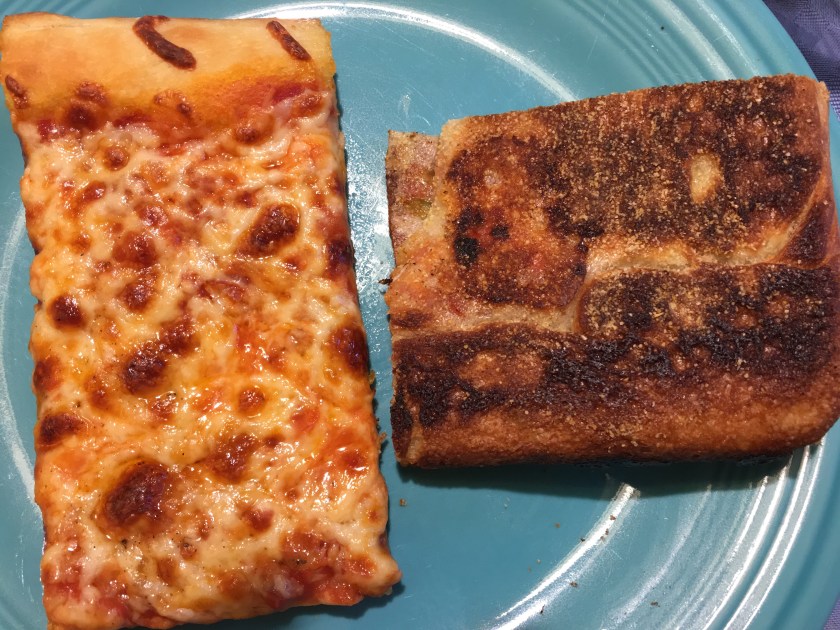
I baked it for 10 minutes at 475 degrees, as indicated in The Joy of Cooking.  I think I often bake pizzas at 450 when I use store-bought dough.  The higher temperature gave us a crispy bottom crust with soft, chewy edges.  It was a hit.

IMG_7280

Here’s the recipe, which is Noni’s with the expanded details I needed from The Joy of Cooking.  It takes a while to make from start to finish, but most of the time is not hands-on.  Since it makes enough for two pizzas, I put one ball of dough aside in the fridge to use another day, which would make this process even faster (assuming it turns out well–more on that once I’ve tried it).

And the big question: does it taste like Noni’s pizza?  Yes and no.  The dough reminds me of hers, but the taste isn’t quite the same.  With such simple ingredients, I have to imagine that one cook’s idiosyncrasies could be tough to identify or replicate.  I know, for example, that Noni cooked with generous amounts of black pepper until she quit smoking around age 70, and her tastebuds recovered.  I may play around with different types of tomato sauce or different amounts of pepper, but this feels like it might be as close as I get to making Noni’s pizza.


(Not) Noni’s Pizza, and not a disaster

As a child, Noni’s pizza seemed different than what I ate at restaurants and sleepovers because she made it in large rectangular pans.  Her pizzas were topped with a simple tomato sauce and mozzarella and, very likely, a bit of parmesan (which is the secret ingredient in many of her savory recipes).  If she ever added other toppings, she must have served those pizzas exclusively to adults.

Last summer, our extended family gathered at the local Italian restaurant to celebrate Noni’s 100th birthday.  One of the appetizers was their house-made pizza, cut into small pieces.  It tasted remarkably like Noni’s pizza, which I hadn’t eaten in many years.  With such simple and so few ingredients, I wondered what gave it such a memorable flavor.

So I came across this recipe and decided to see what I could uncover.

IMG-7118

Another minimal recipe.  The staining tells me that this was frequently used.  I wonder whether it may also be the base for her sausage bread, which was delicious.

I hadn’t made pizza dough from scratch for more than a decade, though I often make pizzas using store-made fresh dough.  I started by mixing together the yeast, water, and sugar.  After it got foamy, I added the salt and oil.

I measured the sifted flour into the standing mixer, then added the other ingredients to it.  The dough came together nicely in the mixer.

Once it was combined, I transferred the dough to a floured wooden board to knead it by hand.  I kneaded it until it came together into a more cohesive ball.  It looked a little deflated and sad when I returned it to the oiled bowl to rise, but the one-year-old had stopped eating her snack, and it was time to move on.

This was a mistake.

An hour later, I had picked up the four-year-old from preschool and was ready to prepare my pizza.  It had risen nicely, if perhaps a little more than expected.  I oiled a pan, halved the dough, refrigerated the extra half for another day, and started to spread it.

I realized almost immediately that it wasn’t right.  The dough wasn’t sufficiently elastic to spread in the pan.  Even though there was plenty of it, it wouldn’t spread without tearing.  I tried working it back together a few times.  Then I looked at The Joy of Cooking, which I’d pulled out to see how long I should let it rise.  Their pizza recipe specifies that it should be mixed in a standing mixer, but then kneaded for 10 minutes.  I maybe kneaded mine for 2.

I was hungry and ready to give up, but my husband was curious to see what it tasted like.  So I sprinkled some cornmeal on one side of the dough, flipped it onto the oiled pan, sprinkled the top with cheddar and mozzarella, and baked it at 475 for 12 minutes.

At this point, I also took out a frozen pizza, to ensure that we’d have something to eat for dinner.

It smelled heavenly.  It looked lovely.  It wasn’t exactly pizza, and it bore no resemblance to Noni’s, but the four-year-old declared it “delicious” and asked me to make it again.  This was high praise after a long day of playing and plentiful snacks at preschool.  We all agreed that it was tastier than frozen pizza.

IMG-7137

Next time, I will knead it for 10 minutes by hand.  On the weekend.

To be continued…

The return of Noni’s Blueberry Muffins

Bold words, I know.

I gave the pseudo-Jordan Marsh blueberry muffins another try, making changes to see if they tasted more like Noni’s muffins.  And they did, at least to me.  It remains to be seen if anyone else who remembers the originals agrees.

A quick aside: if this is the first post that you’re reading, this will make better sense if you first read the previous post about the mysterious Jordan Marsh Blueberry Muffin recipe I found in Noni’s recipe box.  This post is its sequel.

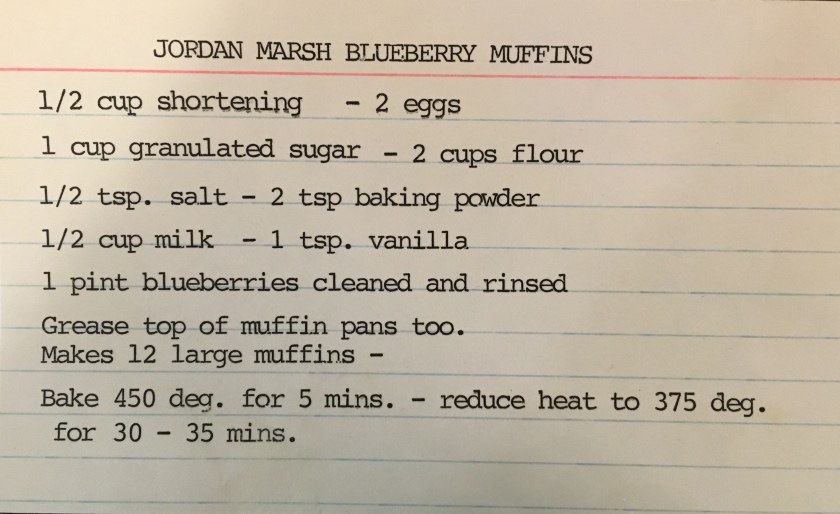
As a reminder, here is the original recipe in its minimalist typed precision:

IMG-6485I made some changes this time:
  • I used butter instead of Crisco (as the online Jordan Marsh recipe specifies)
  • I combined all the wet ingredients and all the dry ingredients separately, before mixing them together
  • I baked them at only one temperature, the lower of the two listed in Noni’s original recipe (also following the online Jordan Marsh muffin recipe)
  • I used the regular bake function on the oven, instead of convect.

It isn’t lost on me that these changes make the recipe closer to the online Jordan Marsh blueberry muffin recipes. Since it still differs in a few ways (no mashed blueberries, no sugar on top), I’m considering this as straying into its own territory.

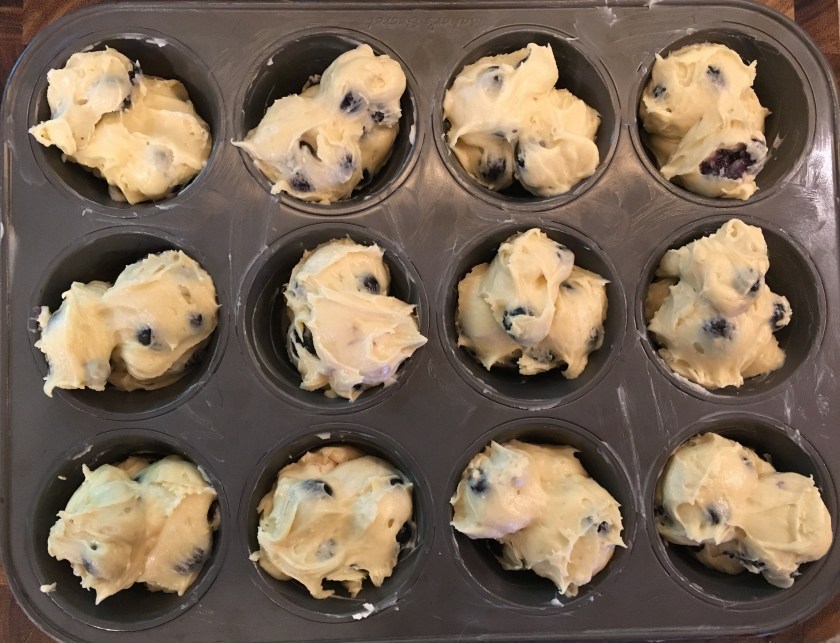
As I started baking, I began to question the wisdom of these changes.  I combined butter, eggs, milk, and vanilla extract together in a batter that looked curdled and like nothing I had ever produced on purpose.  The butter looked like it had separated out in clots.  But my husband urged me on and kept the kids occupied.  And after I added the dry ingredients, the batter started to look like something familiar.

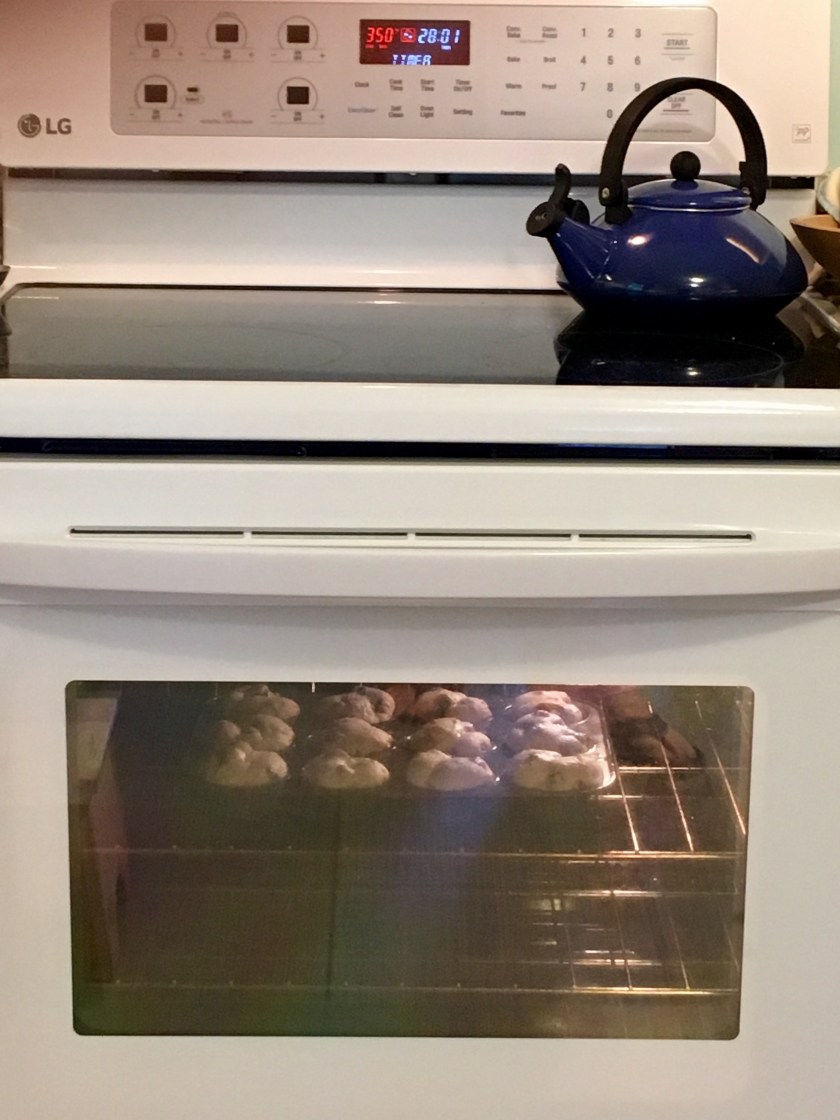
I folded in the blueberries, loaded the large quantity of batter into a greased muffin tin, and baked them at 375 for exactly 30 minutes, this time using the regular baking setting on the oven.

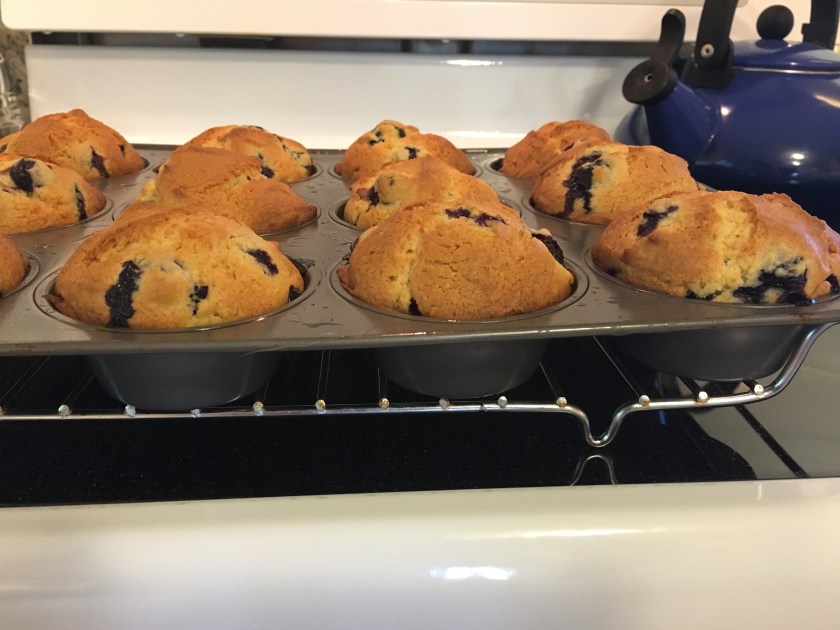
The results were less dense, with a fluffy texture that felt more like a muffin and less like a cake.  I still think Noni’s had higher domes, but for now, this feels like progress towards replicating her muffins.

I’ve entered my adapted version of the recipe into our family’s online recipe database, calling it simply “Noni’s Blueberry Muffins,” because I’m not convinced that they have a clear Jordan Marsh provenance beyond the recipe card I found.

This may not be the final word on Noni’s blueberry muffins.  I have a vague memory of her using Jiffy brand yellow cake mix for many purposes in her kitchen, possibly even for blueberry muffins.  It would make sense when I think of how quickly I remember her whipping these up.  However, the long ingredient list on Jiffy mixes gives this almost-crunchy mom pause, so I’m unsure about pursuing that experiment.  On another health-conscious note, I’m curious about tweaking this recipe to reduce and/or replace the sugar, since it calls for about three times as much as other muffins I make for small children.  Stay tuned.


An almost-mystery of Jordan Marsh Blueberry Muffins

Noni’s blueberry muffins were among the best I’ve tasted.  They had tall, domed tops and fluffy interiors, and were chockfull of blueberries that she and her sister Mary picked at their brother’s nearby farm.  Noni and Mary picked blueberries each year and froze them in batches for baking.  They refused to take my brothers and I with them to their brother’s farm in the next town, never explaining why.  Herein begins the almost-mystery.

Also a bit strange: like me, my brothers remember these muffins with fondness, but our parents have no recollection of Noni ever making blueberry muffins.  I think she often made them when our parents left us to stay at her house while they went out of town.

When I came across this card in Noni’s recipe box, it was one of the first ones I wanted to try.  This is the whole recipe.  Its minimalism is characteristic of Noni’s recipes, but it’s a little unusual in being typed.

img-6485-e1529334498985.jpg

My first attempt at these muffins was on a Saturday morning with no food or caffeine, a 4-year-old’s help, and a 1-year-old eating and throwing Cheerios and toys.

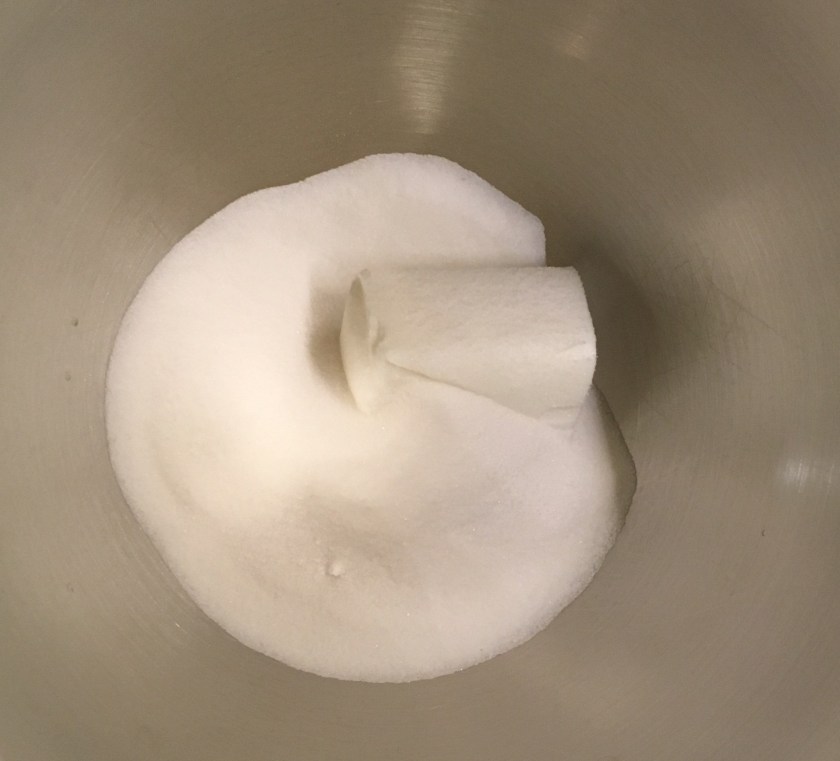
Since the recipe doesn’t include any details on how to combine the ingredients, I  started by creaming together the substantial amounts of shortening and sugar in the standing mixer.  I took the word “shortening” in the recipe to mean Crisco.

IMG-6480

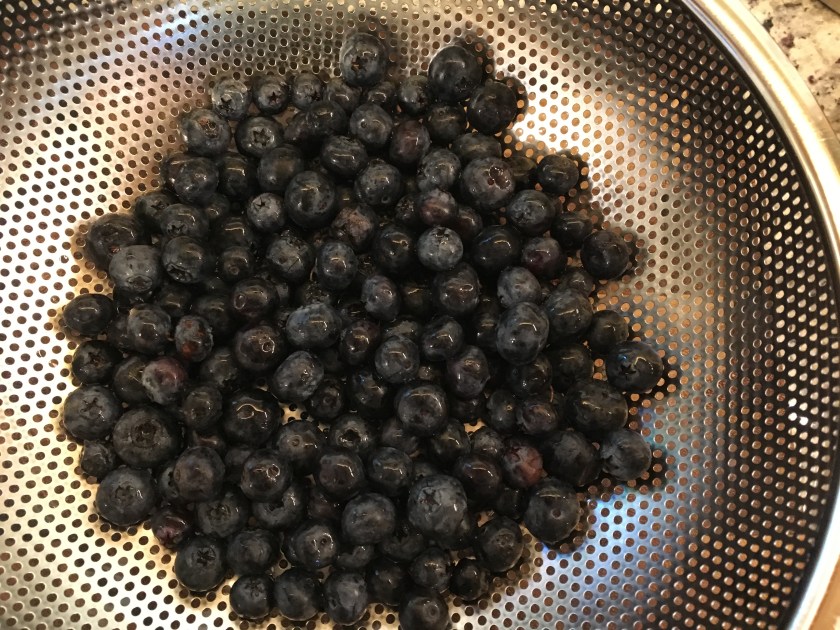
Since I more often bake with butter or safflower oil, using this much Crisco felt like a throwback to another era.  But for this first try, I wanted to make the recipe as-written.  Meanwhile, I put the 4-year-old to work rinsing the blueberries.  A goodly amount were eaten by her and her sister in the process.

IMG-6476

The batter came together like a cake batter, though I mixed in the dry ingredients with only gentle stirring, wanting to make sure that the baking powder batter wasn’t overworked.

IMG-6483

Then I folded in the berries that had survived the girls’ attentions, and we filled the pans. The batter was very thick for muffins, and there was a lot of it. Since the recipe specified that it makes “12 large muffins,” I heaped the batter into the muffin cups, when I normally would have greased a second pan and made a few extra.

img-6484.jpg

The baking instructions in the recipe were a little odd for muffins, starting for 5 minutes at a high temperature, then reducing the temperature for another 30 minutes.  Without thinking much of it (at this point, I’d had caffeine, but no food yet), I used the convection function on our oven. It felt like a long time to bake muffins, and I wondered if it would make for an unusually crispy top.

IMG-6487

The results were somewhat different than I expected, but my family declared them the best blueberry muffins they’d ever had.

IMG-6490

They rose nicely, but not as high as I’d expected.  While I followed the recipe and greased the top of the pan, it wasn’t necessary–they only rose as much as any other well-prepared muffin.  I found the top a bit too crispy and the interior a bit too dense and cake-like.

IMG-6492

The muffins were quickly devoured.  I felt a little disappointed that they weren’t quite the way I’d remembered Noni’s.  Though it may sound twee, I’d hoped that her minimalist recipe might unlock a taste of my childhood.

img-6493.jpg

Nonetheless, they were very tasty with butter. As we ate, my husband and I speculated about why they may have turned out differently than I remembered.  Noni didn’t own a standing mixer, so she probably mixed the batter with a hand-mixer or a spoon.  This might explain why mine were denser; the standing mixer may have over-mixed the dry ingredients, in spite of my attempts to use it sparingly.  Other differences include the fact that her pans were uncoated aluminum and her blueberries were local.  She also never had a convection oven, and we wondered if baking them on the regular setting would better replicate the conditions in her kitchen.

Some will remember that Jordan Marsh, the supposed source of this recipe, was a department store with a bakery in it.  Noni used to take me there to buy special occasion outfits, and she usually got me a black-and-white cookie, though never a blueberry muffin in my memory.

Since making this recipe, I’ve found that Jordan Marsh’s blueberry muffins are well represented on the internet, even though the department store was bought out by Macy’s in the 1990s.  The New York Times, Yankee Magazine, King Arthur Flour, and many home bakers have already posted their versions of this recipe.

Noni’s recipe differs from these online versions in a few ways.  The others call for butter instead of shortening, and only say to bake them at the lower temperature.  They also say to mash some of the blueberries, and to sprinkle the tops with granulated sugar.

The almost-mystery of these muffins: how did Noni’s recipe wind with these differences?  My father explained that she often filled her cookbooks with recipes gathered from newspapers and other sources.  When a cookbook started to overflow, my meticulous grandfather would take out all the clippings and copy the recipes for her.  My dad thinks he sometimes made mistakes in transcription, though this seems amazing to me.  The man was a clock-maker who was incredibly precise in so many things that he did.

After making these pseudo-Jordan Marsh blueberry muffins, I wonder whether this recipe was the one Noni used at all.  I can’t help but notice that the recipe card looks suspiciously clean.  Maybe as I look through Noni’s cookbooks, one of them will fall open to a frequently-opened page with a blueberry muffin recipe.  To be continued.

Benvenuto/Welcome

My Noni is not a stereotype. Yet, like many Italian-American grandmothers, she says “mangia” with great insistence all the cussing time.* Food and my Noni is a complicated topic. Others in my family might admit this, but there’s an unspoken rule that we not discuss family dysfunction outside of the family. But, you know, we’re not a stereotype.

Here is my Noni is as a young woman during World War II. Check out that V for Victory on her thigh, created with tape on a beach visit before the advent of sunscreen. Today she is 101, living in a nursing home about a mile from her birthplace.

A few months ago, I took home her recipe box and the most well-loved (read: dog-eared) of her cookbooks. As I work my way through them and find out what’s delicious, surprising, or no longer appealing, I plan to write about it here and share the recipes. Noni was my first teacher in the kitchen, and now I teach my daughter to make some of the same recipes…except they’re almost never exactly the same. I make different dietary choices than she did in the 1950s and beyond—-for example, less red meat and less Crisco. I’ve also found that some of Noni’s best recipes are barely recorded because she didn’t need to write them down.

*A side note: I say “cussing” here because after four and a half years of parenthood, my brain has been rewired this way. It seems oddly appropriate since my Noni only curses in the nearly-extinct Italian dialect she learned from her parents.

Thanks for joining me and my Noni.